

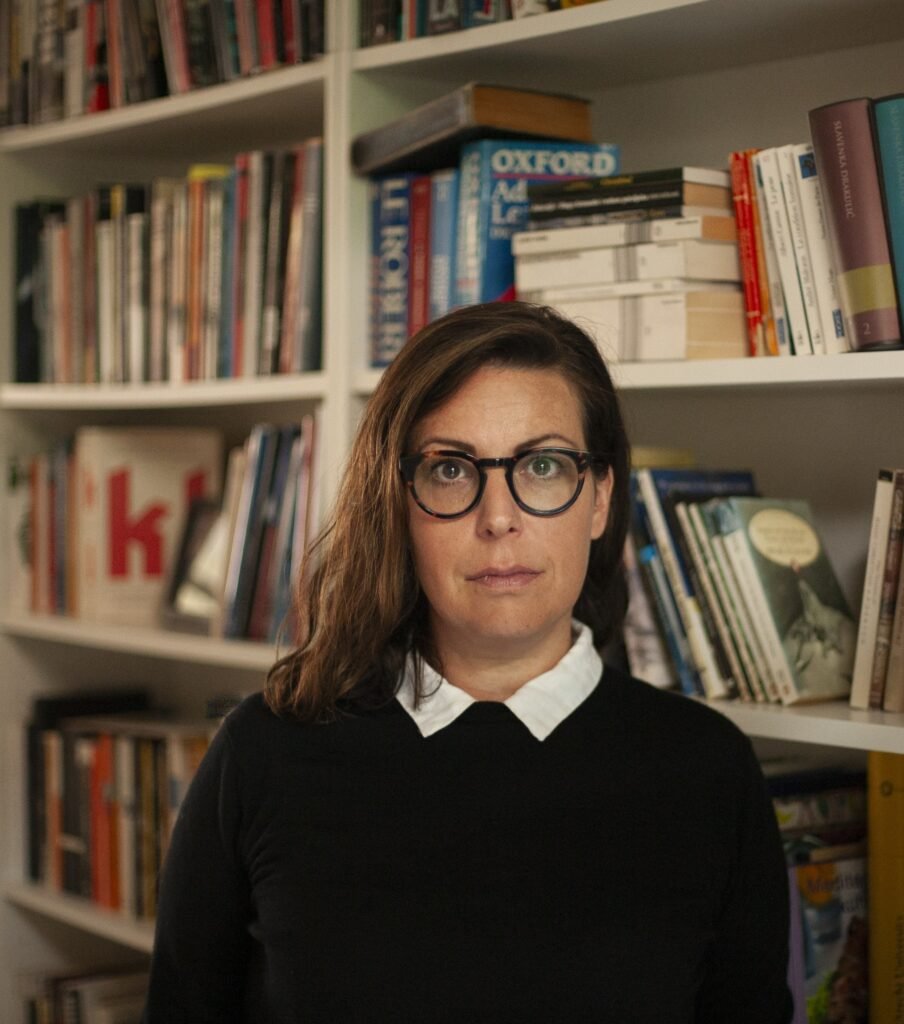

Editors' note: This is a transcription of our “Political Science Podcast” hosted by Enes Kulenović with Iva Vukušić on November 4th 2025. Iva Vukušić is an Assistant Professor in international history at Utrecht University and Visiting Research Fellow at the Department of War Studies at King’s College London.
Enes Kulenović:
Welcome to our political science podcast. Today’s guest is Iva Vukušić. Her research focuses on international justice, particularly criminal accountability for mass atrocities and grave human rights violations. The occasion for today’s conversation is Professor Vukušić’s guest lecture at the Faculty of Political Science in Zagreb, titled “From Ukraine to Gaza: Challenges of International Justice in The Hague in the 21st Century,” as well as her book Serbian Paramilitaries and the Breakup of Yugoslavia, whose Croatian translation was published last year by Naklada Ljevak. Professor Vukušić, welcome to our podcast.
Iva Vukušić:
Thank you for the invitation.
Enes Kulenović:
Let us begin with a question connected to your lecture today. How do you see the role of the International Criminal Court (ICC) and the International Court of Justice (ICJ) in prosecuting crimes in Ukraine and Gaza? More broadly, what are the strengths and weaknesses of these institutions in preventing and responding to mass atrocities? What do these two tragic cases reveal about international justice today?
Iva Vukušić:
Thank you for this very complex question. Ukraine and Gaza have exposed deep, long-standing problems in the international legal system. Those of us who work in this field are not surprised. But since the Russian invasion of Ukraine in 2022 and the developments in Israel and Palestine since 2023, these issues have become visible to a much wider public.
In a way, problems that existed before are now much more radical. We now clearly see the power dynamics and the selective ways in which states respond to international conflicts. This is clearer than ever. I think these institutions matter enormously. I worked for years in the Special Department for War Crimes at the Office of the Prosecutor in Sarajevo, on cases of war crimes, genocide and crimes against humanity. I have spent sixteen years in The Hague, many of them working at what I call “our Hague Tribunal.” But courts alone are not enough. They are like a hose full of water when the fire is already burning.
Courts do not prevent atrocities. They rarely save lives. They intervene only after crimes have been committed. And they are often selective. This is not always their fault, but the fault of politics. International courts are only as strong as states allow them to be. The ICC and ICJ have no money, no police, no enforcement power, without state support. States must implement their decisions. And states are often selective, cynical and inconsistent.
So, much of the criticism aimed at international courts should really be aimed at states. The problem is not the law. Unfortunately, I would say that our problem is politics. I get asked this question often. And I often answer that our problem is not the law, it is politics.
Enes Kulenović:
This then leads me to our second question. Can you explain to us in a little more detail what the political pressures are, especially in these two cases, in the case of the war in Ukraine and the conflict in Gaza? So, the political pressures that both the International Criminal Court and the International Court of Justice are exposed to. And how do these pressures actually affect the work of the courts themselves? Aside from what you have already said, the issue of funding and the fact that the courts do not actually have an army or police force that can enforce their will but have to rely on their members, i.e. signatories, to help them with that. But we know that there is direct pressure from various political actors, especially in these two cases, on the work of the courts themselves.
Iva Vukušić:
Let’s take the ICC. It was established in 1998 by the Rome Statute. For those who are not so immersed in the topic, let me say that it has 125 member states and it prosecutes individuals. And I think the case of the ICC is a lot clearer. Here I just want to list a few things. The International Criminal Court now has more judges and prosecutors who are under US sanctions. They cannot withdraw money from ATMs. If their children study in the US, they are threatened with having their residence permit revoked. Their friends and relatives are afraid to go to the US. A whole range of financial services do not work for them because a lot of banking has to do with American financial institutions. That's one thing. And this is the Trump administration's direct reaction to the investigation into the October 7 attack in Israel. And after that, all the violence in Gaza takes place. Now, I would not hesitate to call this genocide. But we can come back to that later. Chief Prosecutor Karim Khan could not log into his email. Because he is also under sanctions. This has terrible concrete effects on the work of the court. Not only in the investigations concerning Gaza and Palestine. They are active in the Congo, in the Philippines. This has a chilling effect on the court itself. And it is scary. People are afraid. They are afraid to work on these investigations, they are afraid to travel. Because they think that these sanctions could hit them tomorrow. As for Russian pressures, the court was repeatedly exposed to cyber-attacks, theft of information. These are all direct effects associated with those two situations. Which really freeze the work of the court. And they have a discouraging effect on the people who work there, who fear that their phones have been hacked. They cannot talk on the phone.
And finally, there are more subtle pressures from member states. We can talk about that too, in the context of member states who are exerting pressure. Investigate this person, not that one; focus on this event, ignore that one. That is the nature of international institutions. This kind of pressure has always existed. But regarding Ukraine and Gaza, it is more severe and more pronounced, compared to anything that I have seen in about twenty years covering issues of international justice in the Hague.
Enes Kulenović:
One of the criticisms that has been leveled against the International Criminal Court is that it focuses on small targets. From the perspective of international justice, it is important that all crimes be prosecuted. But they mostly prosecute African warlords or similar local powerful people who have committed some crime. And now we have a situation with one of the main allies of the US.
Iva Vukušić:
That is why we are in this situation. Absolutely. If I may say a few things. There is this old criticism that the court is partly a neocolonial institution precisely because it has dealt a lot with African war criminals. And I think that is partly true. There are nuances. African countries have submitted themselves to the authority of the court. A “situation” is the official wording for a country that is under investigation by the International Criminal Court. A number of African countries have submitted themselves to the authority of the court. They would say that after a dictatorship or a war, they cannot prosecute crimes themselves. They say, “we are really not able to. Please help us deal with some of that difficult legacy.” Not all of these cases are something that the court, or the prosecutor himself, has chosen. Or chosen herself, given that before this prosecutor, the prosecutor was a woman, Fatou Bensouda.
But generally speaking, I think the criticism is valid. International institutions, both these and similar ones, have generally dealt with the small, the weak, the enemies and the losers. And to this day, no one has been prosecuted for a whole series of things that we could call historical crimes, from Vietnam, Afghanistan, Iraq. I have lived in the Netherlands for sixteen years, and not a single Dutch person has been prosecuted for similar acts. Not an American, not a Briton, not an Australian.
And this is the first time. Now, we have two high-ranking leaders from Israel, prime minister Netanyahu and former defense minister Gallant. They are the only ones we know about. There may be more arrest warrants that we do not know about. But this is the first time that someone who is a friend, an ally of the West is being prosecuted. That is why I say we are where we are. Because this is the first time we are dealing with someone who is an ally of the West. And many of my colleagues say, and I agree with that, that Palestine is a test case. If international justice can push through, then we have a system that works, and if we cannot push through, then we do not have a system that works. Then we have a system that is selective, which undermines the credibility of the entire system.
Enes Kulenović:
I would like to return to Palestine, Israel and the situation in Gaza. Your lecture today will cover not only the issue of Gaza, but also the war in Ukraine. And here I would refer to an article that you recently published, an article entitled “Accountability for International Crimes in Ukraine.” And here you are discussing the possibility of establishing a special tribunal for crimes of aggression. You discuss it as a certain response to the limited ability of the International Criminal Court to prosecute this type of crime. We talked about crimes, war crimes, crimes against humanity and even genocide. I believe we will come back to that topic, but here we are talking about the crime of aggression, which is both a legal and a moral and political category. So I am wondering if you could explain the idea of a special tribunal for crimes of aggression and how realistic it is that this idea can be realized?
Iva Vukušić:
This is very interesting, because when the International Criminal Court, the ICC, was established about twenty years ago, the guiding idea was that we no longer had to have separate courts. Just like we had our own court for the former Yugoslavia. That was the first modern international criminal court after the end of the Cold War. And for Rwanda. There was a court for Lebanon, but that was something different. There was a court for Cambodia. Now there is a court for Kosovo. We do not have to deal with those details. All of these courts have their own specificities, institutional specificities, and then also with regard to status. But the idea was, when the International Criminal Court was established, that that was it. Now we are not going to invent a new court every time. It is an institution that is tasked with dealing with, in quotation marks, the worst crimes, the largest crimes.
At that time, due to a lack of political agreement between states, aggression was not defined and was not included in the Rome Statute. But there was an idea that aggression would be on the agenda for the International Criminal Court. For those who follow the International Criminal Court, this is a bit funny. The countries that have sabotaged the jurisdiction of the International Criminal Court for aggression are countries that are rich, big and powerful. These are countries that send their troops around the world to do god knows what. Great Britain and France were the key countries that sabotaged the International Criminal Court's ability to deal with aggression. And here they are, ten years later, France and Great Britain want to establish a new court for aggression against Ukraine. Not for other things. Only for Ukraine. This is another example which makes things obvious. You can see from outer space that they are being selective, that this is inconsistent.
The law is complicated. International relations are complicated. I understand that countries have complex positions. And that is perfectly fine. We do not all have to agree on some things. But you cannot have one position one day about what aggression is and how it is defined and how it is prosecuted. And then turn around three days later in a situation that is politically convenient for you. No, now we are for it. That is very important to us now. Three days pass, another situation comes up which is legally identical. Oh, no, now it cannot happen. There is no consistent position, no principles. It is all so political. Let me get back to the idea again. Ukraine and Gaza have exposed that stench. It is disgusting. One day they say one thing, three months later they say something else.
This is the problem of an unprincipled approach that has now been exposed like never before. Now, some paperwork has been signed, this special court for aggression will concern only Ukraine, it will be in The Hague. The paperwork has been signed, the Council of Europe is the umbrella institution. This is again a different legal and institutional regime. It remains to be seen how it will function, who will pay for it. It is easy to talk, but now we need to see who will pay for it. These institutions cost 100 million dollars a year. This court should be a little different in the sense that it should deal only with leadership, because aggression is internationally defined as a crime of leadership.
A war crime can be committed by a soldier. And at the international level, aggression is defined as a crime of leadership. So it is assumed that there could be five, ten, twenty people maybe. So it should be a smaller court. We are now in the first days of defining what it will look like. The court is expected to be in The Hague again. So maybe in a year or so we can meet again and talk about it. But I would say that this is another case of a really selective approach. It is not that I think the Russian leadership should not be tried for a clear violation of international law in invading another country. People should absolutely be prosecuted for this, because the situation is quite clear. It is an international border that they crossed uninvited and without a Security Council mandate. But if we establish a court for Russia, then we should potentially look at some other situations in the same way later, and I am afraid that those same countries will turn around in another situation and say: No, no, no, we do not need it. That is actually our whole problem.
Enes Kulenović:
We entered into the complex topic of the conflict between the real politics of the states themselves and the way in which they try to push their particular interests in the field of international justice. And then we fall into this trap of hypocrisy and inconsistency. And what gives some legitimacy to the whole idea of international justice is precisely a certain consistency which is tested on exactly what you have already mentioned, which is whether it will be applied equally to the weak and the strong.
Iva Vukušić:
That's right. And our friends. Our even us.
Enes Kulenović:
Well, that brings us back to a topic that we have already touched on a little and now I would like to go into it in a little more detail, which is the issue of the conflict in Gaza. The International Court of Justice has made several decisions. The last decision was made at the end of October this year, regarding the potential responsibility of Israeli authorities for the crimes that are taking place in the territory of Gaza. And the court agreed to consider whether events Gaza can be characterized as genocide. The decision on whether it really is genocide or not has not yet been made.
Iva Vukušić:
We may have to wait a few years.
Enes Kulenović:
We may have to wait. We will see whether that decision will be made and when it is made, what the decision will be. To clarify for our listeners, the International Criminal Court makes judgments on individual responsibility and the International Court of Justice makes decisions or judgments in the case of the states that are signatories. And here when we talk about individual responsibility, which falls within the jurisdiction of the International Criminal Court, it has issued arrest warrants for both war crimes and crimes against humanity. You mentioned, against Israeli Prime Minister and against the former Minister of Defense.
Iva Vukušić:
And three members of Hamas, who are all dead. They have been killed.
Enes Kulenović:
You have been dealing with this topic for years. What is your view? How would you characterize the fact that today nobody, not even the most vocal advocates, on either side, neither pro-Palestinian nor pro-Israeli, is denying that mass crimes were committed on both sides? How can we best characterize these crimes from the perspective of international justice?
Iva Vukušić:
I have no interest in being for or against anything. I have never been to Israel or Palestine in my life. I do not speak those languages. I do not have family there. I have not set foot there. I really have no reason to be for or against either side. I am for international law. That is it. I think you are absolutely right when you say that both sides have undoubtedly committed mass crimes. It is extremely important for me to say that it seems to me that there is something unhealthy here. I see that in other cases as well. And I would call that an obsession with the term genocide.
Enes Kulenović:
I agree.
Iva Vukušić:
I have a feeling that we are all obsessed with that term. And then one has the feeling that if a court at the end of the day says that something is not genocide, it is as if nothing happened. At the International Criminal Tribunal for the former Yugoslavia, at what I call “our court”, there was great drama surrounding numerous indictments. But especially regarding the Mladić and Karadžić cases and the question of whether genocide was committed in Prijedor and in the camps Omarska, Keraterm, Trnopolje. Is this expulsion, murder, torture, sexual assault and so on, is it genocide? The court eventually said no. I felt that it was a terrible disappointment to many and that it devalued their suffering. Of course, genocide is a terrible crime, but legally speaking, war crimes are terrible and crimes against humanity are terrible. All of this is terrible and this is not a competition. It is all torture, rape, killing, mistreatment, humiliation. One does not know what is worse. I would not like it to seem as if there is some kind of ranking. There is no ranking.
Even if some court at some point said that what is happening in Gaza is not genocide, that does not mean that it is okay. What is happening there now is oppression that has been going on for two years. Bombing, starvation, mistreatment. And what is also terribly important is that it is happening in the context of the colonial seizure of land in the West Bank. These people from Gaza cannot leave, cannot travel. This has nothing to do with events after 2023. And as you mentioned, the International Court of Justice has several different cases. One case was about occupation. Last summer, the court said that Israel must withdraw from the areas occupied in 1967. That it must stop building illegal settlements in the West Bank. Recently, there was also a case regarding obligations to the UN and humanitarian aid. The genocide case was brought by South Africa against Israel.
Even if in that case the court eventually says that what is happening is not genocide, what is happening is still terrible. What Hamas did on October 7, when they stormed into small towns near Gaza, into kibbutzes, killing people in pajamas and abducting children, was also terrible. It is all terrible. I do not know what else to say, it is all together terrible.
You will forgive me for the long answer. But genocide is very difficult to prove in the courtroom. Everyone who followed our court, who followed the trials for Srebrenica, will know this. Because there is that element of intent, genocidal intent. That is hard to prove. We cannot enter someone's mind, someone's head. Most leaders are not total idiots. They do not write orders that say: Dear troops, go there, kill civilians, rape, burn everything. With the goal of extermination. With a stamp and a signature. They are not stupid. So there are many more genocides in the world than there are verdicts.
I think that is one of the reasons why the prosecutor at the International Criminal Court has not filed an indictment for genocide. As far as we know. Arrest warrants can be issued without public knowledge. As far as we know, the current indictments are for war crimes, for crimes against humanity. Genocide is difficult to prove. The International Criminal Court is in trouble anyway. These prosecutors are bigwigs who do not like to lose. They do not want to bring a case they are not going to win. So there are numerous reasons why we might not actually have a verdict. Personally, for the first year of Israel's attack on Gaza, I did not feel comfortable using the word genocide for what was happening. Because I thought, I am not sure, it is not up to me, it is up to the judges to say.
At one point, sometime in the spring of this year, I realized that it was not morally sustainable to sit on a branch and remain silent. I am now in a position to say: If this is not genocide, then I really do not know what genocide is. Then please explain to me what genocide is. So that is why I started to come forward with this position. But for the first year, I was careful. Among my contacts are many colleagues who deal with this. I think that there is more and more a consensus that it either is genocide, or it very likely is genocide. Among my friends and colleagues, there is no one who says: No, there is no way. That is simply no longer a position that people in my circles professionally advocate.
Enes Kulenović:
I am especially glad that you made this distinction of genocide as a legal category, within international law and the way in which we in our discourse, especially in political discourse, use the term genocide, which is then attributed a certain moral weight as the worst possible crime.
It is important in the context of international justice, as already mentioned, that there is a certain consistency in applying these standards, humanitarian standards to the entire world in equal measure. We know that the courts themselves, in this case these two courts that we have been talking about, the International Court of Justice and the International Criminal Court, may not be able to prevent crimes. But it is important that there is at least the possibility that those who were the architects of these crimes are punished, regardless of whether the crime is then characterized as genocide, ethnic cleansing, a crime against humanity or a war crime. But that they are punished. And another important element is that it remains documented. You have dealt with this in your works. That it is recorded, that is, that there is some historical footprint. It is at least some kind of consolation for those who were exposed to these mass crimes. In the case of what happened in Bosnia, it turns out that it does have some meaning. That it remains historically documented.
I would like to briefly discuss another topic, which I have already announced, which is your book Serbian Paramilitaries and the Breakup of Yugoslavia. The book was published by Routledge in 2023 and a Croatian edition was also published last year, which we are particularly pleased about because it means we can also use it in teaching.
Iva Vukušić:
I am very happy to hear that.
Enes Kulenović:
One question seems inevitable.
Iva Vukušić:
Why Serbian paramilitaries? Many people ask me that. That is a common first question.
Enes Kulenović:
No, no. That could be one question. Maybe my question covers that question as well. And that is: what was your main motive? You have already mentioned that you spent a large part of your academic career, your professional career, very close to the court in The Hague. So in a way, you were in the field. But purely intellectually and scientifically, what was the motive for you to take on this interesting topic which, we must admit, is an insufficiently researched topic so far?
Iva Vukušić:
Well, that was the reason I wrote the book. I started my doctoral studies in Utrecht in 2015. I worked first at Radio 101 and then at the court at the Sense agency. I followed the court for about ten years. I knew the exhibit numbers, the witnesses by heart. This witness in this trial, in that trial. This is his synonym here and this is his synonym there. I can still quote entire pieces of testimony by heart today. For example, in one case, the case of the Srebrenica survivors, maybe some listeners will know, in the Krstić case, one witness talked about how he did not want to die thirsty. I know that part by heart. If you wake me up at two in the morning, I can tell you that.
And then it occurred to me, well, I have been here for years, I know it by heart, and it is not in the books. So why is it not in the books? There have been many books about the breakup of Yugoslavia. I am not saying we should not continue to deal with it. There must be something more, more elements.
Enes Kulenović:
The topic is not exhausted.
Iva Vukušić:
It is not exhausted. But there are many studies and there are really good studies. So I thought about what I could contribute. And in conversations with colleagues and mentors and supervisors, I decided to write a book about Serbian paramilitaries. And maybe to answer that question, which people often ask, why Serbian? And that, I think, is on the second page of the book. I always get asked that because I am from Croatia, I talk the way I talk. I grew up in Zagreb. I am a citizen of the Republic of Croatia, although I do not identify ethnically. But when I travel, people see me as someone who does identify ethnically. So I have to constantly explain myself about that.
The explanation is that Serbian paramilitaries were the most numerous. They were engaged from Croatia to Bosnia to Kosovo. They waged war for ten years on a vast terrain and killed more people than others. I think that this is something that is clear. Crimes were committed on the other side as well. When we say on the other side, I mean that in quotation marks. Because it is too simplistic. Each side, the Croatian side, Bosnian, Serbian, they all quarreled among themselves. So that should also be emphasized. They all had paramilitaries and regular troops and they all committed crimes. Absolutely everyone committed crimes, only some did so more than others. So my plan was that I would contribute as much as I could by covering some paramilitaries and then my colleagues could write books on the subject of other units.
Enes Kulenović:
That is immediately clear to anyone who opens your book. There is no bias, you clearly say right from the start that the paramilitaries of all sides were involved in both human rights violations and crimes. But your study focuses on these paramilitaries, precisely for these reasons that you said and because of the material that was available to you.
Iva Vukušić:
And maybe just one more small detail. Perhaps more attentive readers will notice, I do not use the term “Homeland War.” I use the term “war in Croatia.” I am not here to be a Croatian, nor a citizen of the Republic of Croatia, for me it is like any other war, anywhere else. And this was important to me when we were translating the book, that was the first thing I said to my translator. Because in my opinion, a “homeland” is an emotional category. And I have to have a distance if I aspire to some scientific position. So I insisted on that. I tried not to write the book as a book by a Croatian woman, but as a book by a historian.
Enes Kulenović:
Another question regarding your book is what are the main conclusions you reached in the book? I admit that this is a thankless question, considering that it is a very extensive book. While reading, I found the insights into the relationship between state actors and paramilitary forces particularly interesting.
Iva Vukušić:
This is a phenomenon that can be seen in other cases as well. Perhaps our listeners followed the involvement of Wagner on the Russian side in the war in Ukraine. It has now been several years since Yevgeny Prigozhin and his team fell from the sky in a plane. And their name has changed. Now they operate under a different name and are organized differently, but the principle is the same. There are various paramilitaries. They are a paramilitary that is in the service of the state. That kind of paramilitary, like Wagner, like the units I wrote about in the book, are there to do the dirty work for the state. So that the state can get rid of people, kill them, throw them into camps, get rid of them in some way, and avoid sanctions, either criminal or diplomatic. States use this type of actor to do their dirty work for them. In the book, I called this the “outsourcing” of violence. And I think that is something that gives the state protection. These dirty jobs were done, but not by the official police, not by the official army.
It should be known that without the state, these paramilitaries would not exist. They would not have buses, uniforms, they would not have weapons, the borders would not be opened for them to go wherever they want, they would not be allowed to loot, to take those refrigerators and washing machines home to Serbia. So the state is crucial. And I think it is important to know that not all these units are the same. In my research, I discovered that the way they are established often affects the kind of violence they commit. Some commit very public violence, so that everyone can see it, so that everyone can hear the screams. And some kill and torture in the basements of police stations without others seeing. So this world is much more diverse than people would often say at first.
Enes Kulenović:
Since we are on the “Political Science Podcast”, we also like to ask our guests about their future research and possible potential publications. Because you have an interesting scientific background. You are both a political scientist and a historian and you combine this in an interesting way. We here in Zagreb believe that such multidisciplinary approaches are extremely fruitful. So I wanted to ask you a little about that as well. So, two questions in one. First, what are your plans for research and publications in the near future, where have you directed your scientific interest? And second, a little more broadly, what are the topics or approaches that you find interesting for researchers, who like you, rely on both political science and history.
Iva Vukušić:
That is a very interesting question. If I say what I am planning now, then I have to be responsible and I have to publish it. I have been living in The Hague for the last 16 years, I breathe those courts. I watch those trials like others watch TV shows, I go to those courts and follow those trials. And I remember Karadžić and Mladić, I sat through both those trials from start to finish, five years, four to five days a week, that is a full time job. And that is it, I think. I will live in The Hague for the rest of my life and research those trials. I just have to see what aspect to focus on. I work at the crossroads between international history, international law and international relations. I am interested in those institutions and I am fundamentally interested in them when the world is burning. When people are being killed and oppressed, what can those international judicial institutions do?
My scientific mission is to popularize some of these things. Because it seems to me that people, citizens, do not understand these institutions. Just like I do not understand climate change, so I want someone to explain it to me. That is how I see my role in helping people with these topics. Is what is happening in Gaza a genocide or not? They need to know what genocide is, where that term comes from, what is going on there. That is my mission. So I think my future work will have that public element. Maybe my next book will be about that. We live in a time when, as I like to say, some of the stink in all of this has been exposed. And I would like to record that, understand it, for myself. Because I have been at these trials for twenty years now. There comes a moment in middle age when you ask yourself: My god, what am I wasting my life on? Does this make sense? What are we all doing here in The Hague?
Because we are really at a point now where this system of justice is either going to move towards something better and fairer or it is all going to fall apart. Maybe it is all going to fall apart. Goodbye, we are done. I would like to write something that is oriented toward the broader public. I have an article about how reconciliation is not something we should expect from the courts. It is about what the courts are, what they can give us in these difficult times and what is not fair to expect from them.
Enes Kulenović:
We are looking forward to that. Thank you. If it will be published in English, we look forward to a Croatian translation. Profesor Vukušić, thank you for talking to us.
Iva Vukušić:
Thank you for the invitation.
Enes Kulenović:
I hope there will be an opportunity to talk about these topics in the future.
Iva Vukušić:
Me too. Thank you.

